
StateVar Filter
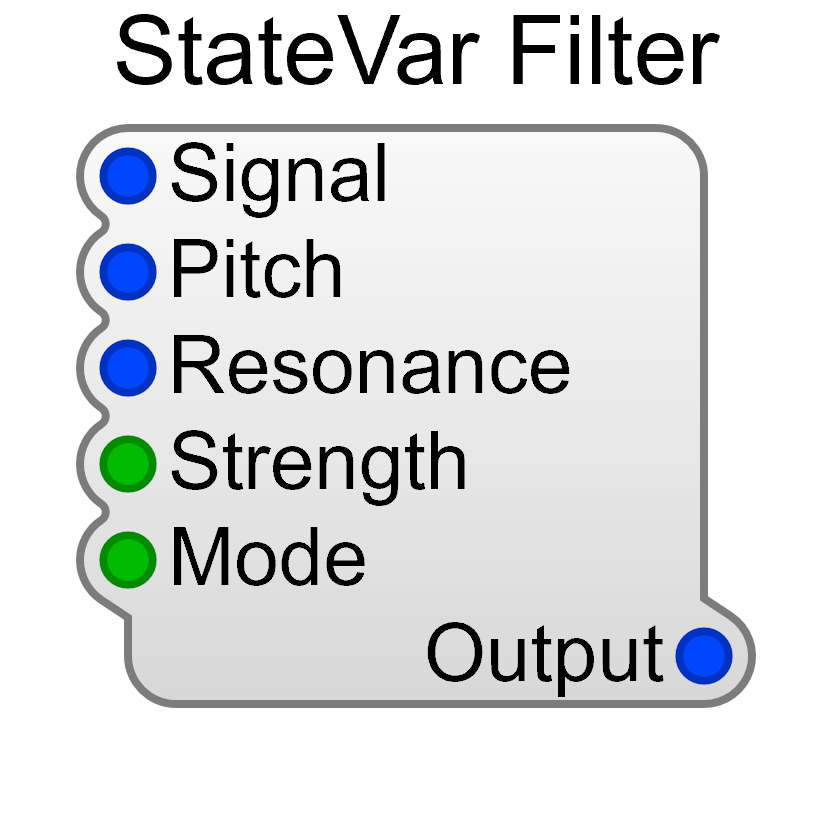
The StateVar Filter is SynthEdit’s virtual-analogue state variable filter. It uses a topology-preserving transform (TPT), which keeps the filter’s tuning accurate and its behaviour stable even while the cutoff is being swept — including close to the Nyquist frequency, where older designs lose accuracy and start to sound muffled.
Both Pitch (cutoff) and Resonance are audio-rate inputs, recalculated every sample rather than once per processing block. At high resonance this is what keeps a swept cutoff smooth instead of stepping audibly.
Hear it in the audio demos.
Inputs
Section titled “Inputs”| Pin | Type | Description |
|---|---|---|
| Signal | Audio | Audio input to filter |
| Pitch | Audio | Cutoff frequency (1V/octave, 5V = 440 Hz) |
| Resonance | Audio | Resonance / Q amount |
Outputs
Section titled “Outputs”| Pin | Type | Description |
|---|---|---|
| Output | Audio | Filtered output, in the selected mode |
Parameters
Section titled “Parameters”| Property | Description |
|---|---|
| Mode | Low Pass, High Pass, Band Pass or Band Reject |
| Strength | 1-Stage (6 dB/octave) or 2-Stage (12 dB/octave) rolloff |
Patch an envelope or LFO into Pitch for a swept filter. Because Pitch is an ordinary audio-rate pin, you can also patch an audio oscillator into it — the filter will track it at full rate.
Raising Resonance emphasises the frequencies around the cutoff. Combined with an envelope sweep and 2-Stage strength, this gives the classic subtractive-synth filter sweep.
If you need several filter types from the same input at once, the StateVar Filter (multi) variant provides low-pass, high-pass, band-pass and band-reject outputs simultaneously.
For a heavier, more saturated character see the Moog Filter. The older SV Filter remains available for compatibility with existing projects.